Who's That Player?: Externalizing Query Interpretation in Spoken XR Sports Interaction
IEEE Transactions on Visualization on Computer Graphics (IEEE VIS), 2026.
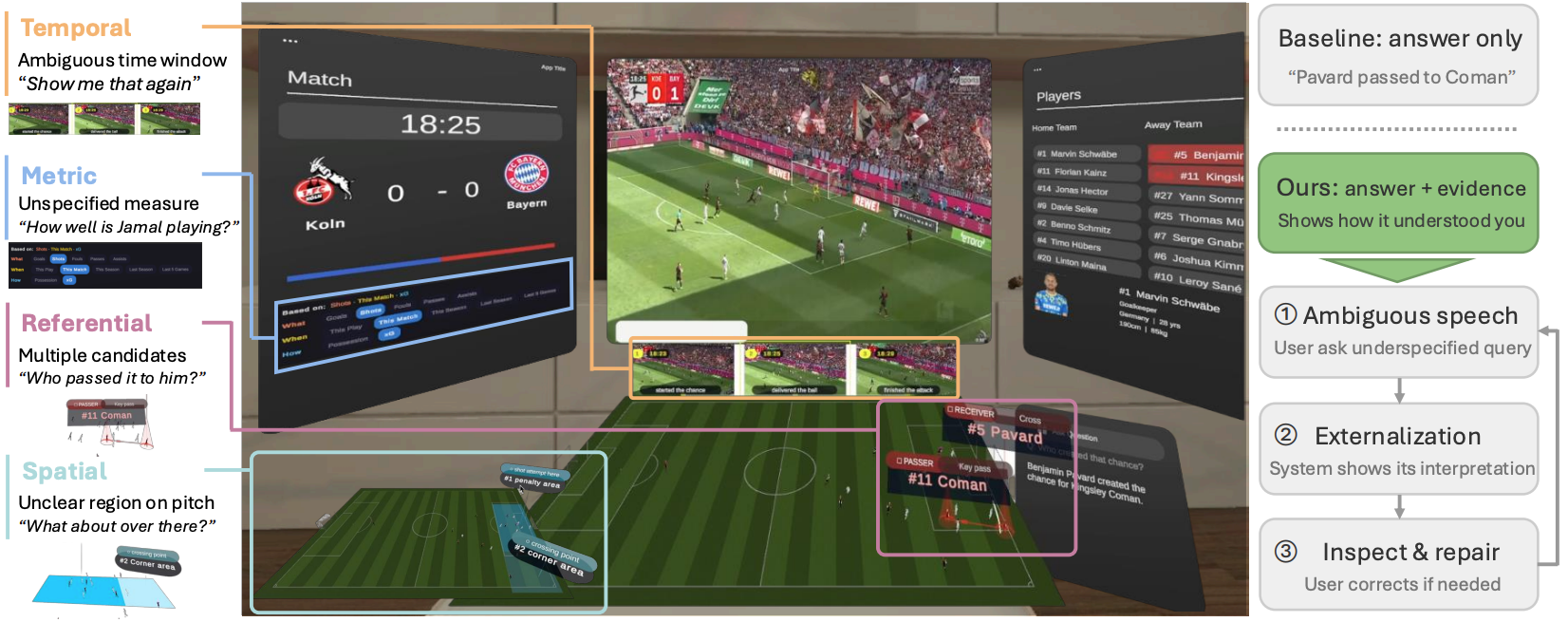
XR sports viewing enables spectators to follow play from immersive, spatially anchored perspectives while accessing contextual analytics directly within the scene. In such settings, speech offers a practical interaction modality because text entry and menu navigation can interrupt attention during fast-paced gameplay. However, spoken queries are often underspecified: viewers may omit which player, time period, field location, or metric they intend. When systems resolve these ambiguities implicitly, their assumptions remain hidden, making misinterpretations difficult to notice and correct (repair). We investigate how externalizing a system's interpretation of spoken queries can support inspection and correction of such misunderstandings in XR sports viewing. Through a formative study, we identified four recurring ambiguity types (referential, spatial, temporal, and metric) that characterize ambiguous spoken queries in this context. We develop a design space that organizes externalization along three dimensions (ambiguity type, interpretation state, externalization strategy) and instantiate it in an interactive XR soccer viewing system that combines situated visual cues with supporting analytic views. A within-subjects user study (N=16) comparing externalized interpretation against a voice-only baseline reveals that externalization is associated with higher inspectability on most measured dimensions and increased explicit repair language overall. However, repair occurred in only 38% of misaligned externalization trials, and this visibility-action gap varied by ambiguity type, indicating that transparency and correction affordance are orthogonal design axes.
Acknowledgements
This work was supported by NIH grant 1U01CA284207 and Harvard Data Science Initiative Trust in Science Fund Award.